
 購物車
購物車 
-
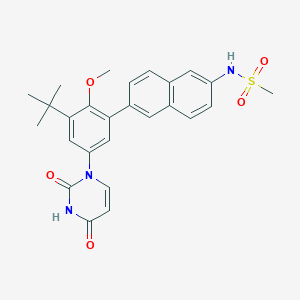
達拉他韋
- names:
Dasabuvir
- CAS號:
1132935-63-7
MDL Number: MFCD27923655 - MF(分子式): C26H27N3O5S MW(分子量): 493.57
- EINECS: Reaxys Number:
- Pubchem ID:56640146 Brand:BIOFOUNT
達拉他韋(Dasabuvir,1132935-63-7)是丙型肝炎病毒(HCV)非結構蛋白5B(NS5B)的一種非核苷抑制劑,RNA依賴性RNA聚合酶具有抗HCV的潛在活性。在細胞內攝取后,達拉他韋結合HCV NS5B聚合酶并阻斷病毒RNA的合成和復制。HCV NS5B蛋白對于HCV RNA基因組的復制至關重要。 HCV是屬于黃病毒科的小型帶包膜單鏈RNA病毒; HCV感染與肝細胞癌(HCC)的發展有關。
| 貨品編碼 | 規格 | 純度 | 價格 (¥) | 現價(¥) | 特價(¥) | 庫存描述 | 數量 | 總計 (¥) |
|---|---|---|---|---|---|---|---|---|
| YZM000559-10mg | 10mg | 98.05% | ¥ 926.00 | ¥ 926.00 | 2-3days | ¥ 0.00 | ||
| YZM000559-5mg | 5mg | 98.05% | ¥ 598.00 | ¥ 598.00 | 2-3days | ¥ 0.00 |
| 中文別名 | 達拉他韋(cas:1132935-63-7) |
| 英文別名 | Dasabuvir(cas:1132935-63-7),ABT 333,abt333,ABT-333,dasabuvirum,dasabuvir |
| CAS號 | 1132935-63-7 |
| Inchi | InChI=1S/C26H27N3O5S/c1-26(2,3)22-15-20(29-11-10-23(30)27-25(29)31)14-21(24(22)34-4)18-7-6-17-13-19(28-35(5,32)33)9-8-16(17)12-18/h6-15,28H,1-5H3,(H,27,30,31) |
| InchiKey | NBRBXGKOEOGLOI-UHFFFAOYSA-N |
| 分子式 Formula | C26H27N3O5S |
| 分子量 Molecular Weight | 493.57 |
| 溶解度Solubility | 生物體外In Vitro:DMSO溶解度≥ 46 mg/mL(93.20 mM)*"≥" means soluble可溶, but saturation unknown溶解度未知. |
| 性狀 | 固體粉末,Power |
| 儲藏條件 Storage conditions | -20°C 3 years年 4°C 2 years年 / In solvent溶液中:-80°C 6 months月 -20°C 1 month月 |
Dasabuvir(CAS:1132935-63-7)實驗注意事項:
1.實驗前需戴好防護眼鏡,穿戴防護服和口罩,佩戴手套,避免與皮膚接觸。
2.實驗過程中如遇到有毒或者刺激性物質及有害物質產生,必要時實驗操作需要手套箱內完成以免對實驗人員造成傷害
3.實驗后產生的廢棄物需分類存儲,并交于專業生物廢氣物處理公司處理,以免造成環境污染Experimental considerations:
1. Wear protective glasses, protective clothing and masks, gloves, and avoid contact with the skin during the experiment.
2. The waste generated after the experiment needs to be stored separately, and handed over to a professional biological waste gas treatment company to avoid environmental pollution.
Tag:達沙布韋蒸汽壓,達沙布韋合成,達沙布韋標準,達沙布韋應用,達沙布韋合成,達沙布韋沸點,達沙布韋閃點,達沙布韋用途,達沙布韋溶解度,達沙布韋價格,達沙布韋作用,達沙布韋結構式,達沙布韋用處
1.實驗前需戴好防護眼鏡,穿戴防護服和口罩,佩戴手套,避免與皮膚接觸。
2.實驗過程中如遇到有毒或者刺激性物質及有害物質產生,必要時實驗操作需要手套箱內完成以免對實驗人員造成傷害
3.實驗后產生的廢棄物需分類存儲,并交于專業生物廢氣物處理公司處理,以免造成環境污染Experimental considerations:
1. Wear protective glasses, protective clothing and masks, gloves, and avoid contact with the skin during the experiment.
2. The waste generated after the experiment needs to be stored separately, and handed over to a professional biological waste gas treatment company to avoid environmental pollution.
Tag:達沙布韋蒸汽壓,達沙布韋合成,達沙布韋標準,達沙布韋應用,達沙布韋合成,達沙布韋沸點,達沙布韋閃點,達沙布韋用途,達沙布韋溶解度,達沙布韋價格,達沙布韋作用,達沙布韋結構式,達沙布韋用處
| 產品說明 | 達沙布韋(Dasabuvir,1132935-63-7)是一種有效的非核苷的抑制劑,達沙布韋溶解度,達沙布韋MSDS詳見主頁。 |
| Introduction | Dasabuvir(達沙布韋,1132935-63-7) (ABT33) is a nonnucleoside inhibitor of the RNAependent RNA polymerase encoded by theHCV NS5Bgene |
| Application1 | 達沙布韋(Dasabuvir,1132935-63-7)抑制RNA依賴性的HCV NS5B基因編碼的 RNA 聚合酶,抑制 HCV 基因型 1a 和 1b 臨床分離株衍生的重組 NS5B 聚合酶,IC50是 2.2 到 10.7 nM |
| Application2 | |
| Application3 |
| 警示圖 | |
| 危險性 | warning |
| 危險性警示 | Not available |
| 安全聲明 | H303吞入可能有害+H313皮膚接觸可能有害+H2413吸入可能對身體有害 |
| 安全防護 | P264處理后徹底清洗+P280戴防護手套/穿防護服/戴防護眼罩/戴防護面具+P305如果進入眼睛+P351用水小心沖洗幾分鐘+P338取出隱形眼鏡(如果有)并且易于操作,繼續沖洗+P337如果眼睛刺激持續+P2393獲得醫療建議/護理 |
| 備注 | 實驗過程中防止吸入、食入,做好安全防護 |
| 2017-07-01 Resistance Mechanisms in Hepatitis C Virus: implications for Direct-Acting Antiviral Use Drugs |
| 2016-08-01 Metabolism and Disposition of Hepatitis C Polymerase Inhibitor Dasabuvir in Humans Drug metabolism and disposition: the biological fate of chemicals |
| 2016-01-01 Dasabuvir (ABT333) for the treatment of chronic HCV genotype I: a new face of cure, an expert review Expert review of anti-infective therapy |
| 2016-01-01 New direct-acting antivirals in hepatitis C therapy: a review of sofosbuvir, ledipasvir, daclatasvir, simeprevir, paritaprevir, ombitasvir and dasabuvir Expert review of clinical pharmacolo |
| 2015-09-01 Interferon-free therapy for hepatitis C: The hurdles amid a golden era Digestive and liver disease : official journal of the Italian Society of Gastroenterology and the Italian Association |
1.Clinical Pharmacokinetics of Dasabuvir Clinical Pharmacokinetics 2017
Abstract:Dasabuvir is a nonstructural (NS) 5B non-nucleoside inhibitor of the hepatitis C virus (HCV) used in combination with ombitasvir/paritaprevir/ritonavir for the treatment of chronic HCV infection. It is primarily metabolized by cytochrome P450 (CYP) 2C8, with a minor contribution from CYP3A. Biotransformation of dasabuvir forms the M1 metabolite, which retains antiviral activity. Dasabuvir exhibits linear pharmacokinetics with a terminal half-life of approximately 5–8 h, allowing for twice-daily dosing. The M1 metabolite of dasabuvir is the major metabolite in plasma and has a half-life similar to that of dasabuvir. Dasabuvir exposures in Asian subjects are comparable with Caucasian subjects. The pharmacokinetic characteristics of dasabuvir are similar between healthy subjects and HCV-infected patients, and are not appreciably altered by mild , moderate, or severe renal impairment or dialysis. Dasabuvir pharmacokinetic parameters were not significantly altered in subjects with mild or mo derate hepatic impairment; however, exposures were significantly increased in subjects with severe hepatic impairment. Dasabuvir should be administered with food to maximize absorption. Coadministration of dasabuvir with a strong CYP2C8 inhibitor increased dasabuvir exposures by greater than tenfold, whereas coadministration with strong CYP3A inhibitors increased dasabuvir exposures by less than 50%. Furthermore, coadministration of dasabuvir with a CYP3A inducer decreased dasabuvir exposures by 55–70%. Coadministration of dasabuvir with strong CYP2C8 inhibitors or strong CYP3A/CYP2C8 inducers is contraindicated. Results from drug several interaction studies demonstrated that dasabuvir in combination with ombitasvir/paritaprevir/ritonavir can be coadministered with most comedications that are commonly prescribed in HCV-infected patients.
2. Ombitasvir/Paritaprevir/Ritonavir Plus Dasabuvir: A Review in Chronic HCV Genotype 1 Infection Drugs 2015
Abstract:A fixed-dose tablet comprising ombitasvir (an NS5A replication complex inhibitor), paritaprevir (an NS3/4A protease inhibitor) and ritonavir (a cytochrome P450 inhibitor) taken in combination with dasabuvir (an NS5B polymerase inhibitor) is indicated for the treatment of chronic hepatitis C virus (HCV) genotype 1 infection in several countries, including the USA (copackaged as Viekira Pak™) and those of the EU (Viekirax® and Exviera®). In phase II and III trials, this interferon-free regimen, taken ± ribavirin, provided high rates of sustained virological response 12 weeks post-treatment in adults with chronic HCV genotype 1a or 1b infection, including those with compensated cirrhosis, liver transplants or HIV-1 co-infection. The regimen was generally well tolerated, with nausea, insomnia, asthenia, pruritus, other skin reactions and fatigue being among the most common tolerability issues., ombitasvir/ Thusparitaprevir/ritonavir plus dasabuvir is an effective interferon-free, direct-ac ting antiviral regimen for use ± ribavirin in a broad range of adults chronically infected with HCV genotype 1.
Abstract:Dasabuvir is a nonstructural (NS) 5B non-nucleoside inhibitor of the hepatitis C virus (HCV) used in combination with ombitasvir/paritaprevir/ritonavir for the treatment of chronic HCV infection. It is primarily metabolized by cytochrome P450 (CYP) 2C8, with a minor contribution from CYP3A. Biotransformation of dasabuvir forms the M1 metabolite, which retains antiviral activity. Dasabuvir exhibits linear pharmacokinetics with a terminal half-life of approximately 5–8 h, allowing for twice-daily dosing. The M1 metabolite of dasabuvir is the major metabolite in plasma and has a half-life similar to that of dasabuvir. Dasabuvir exposures in Asian subjects are comparable with Caucasian subjects. The pharmacokinetic characteristics of dasabuvir are similar between healthy subjects and HCV-infected patients, and are not appreciably altered by mild , moderate, or severe renal impairment or dialysis. Dasabuvir pharmacokinetic parameters were not significantly altered in subjects with mild or mo derate hepatic impairment; however, exposures were significantly increased in subjects with severe hepatic impairment. Dasabuvir should be administered with food to maximize absorption. Coadministration of dasabuvir with a strong CYP2C8 inhibitor increased dasabuvir exposures by greater than tenfold, whereas coadministration with strong CYP3A inhibitors increased dasabuvir exposures by less than 50%. Furthermore, coadministration of dasabuvir with a CYP3A inducer decreased dasabuvir exposures by 55–70%. Coadministration of dasabuvir with strong CYP2C8 inhibitors or strong CYP3A/CYP2C8 inducers is contraindicated. Results from drug several interaction studies demonstrated that dasabuvir in combination with ombitasvir/paritaprevir/ritonavir can be coadministered with most comedications that are commonly prescribed in HCV-infected patients.
2. Ombitasvir/Paritaprevir/Ritonavir Plus Dasabuvir: A Review in Chronic HCV Genotype 1 Infection Drugs 2015
Abstract:A fixed-dose tablet comprising ombitasvir (an NS5A replication complex inhibitor), paritaprevir (an NS3/4A protease inhibitor) and ritonavir (a cytochrome P450 inhibitor) taken in combination with dasabuvir (an NS5B polymerase inhibitor) is indicated for the treatment of chronic hepatitis C virus (HCV) genotype 1 infection in several countries, including the USA (copackaged as Viekira Pak™) and those of the EU (Viekirax® and Exviera®). In phase II and III trials, this interferon-free regimen, taken ± ribavirin, provided high rates of sustained virological response 12 weeks post-treatment in adults with chronic HCV genotype 1a or 1b infection, including those with compensated cirrhosis, liver transplants or HIV-1 co-infection. The regimen was generally well tolerated, with nausea, insomnia, asthenia, pruritus, other skin reactions and fatigue being among the most common tolerability issues., ombitasvir/ Thusparitaprevir/ritonavir plus dasabuvir is an effective interferon-free, direct-ac ting antiviral regimen for use ± ribavirin in a broad range of adults chronically infected with HCV genotype 1.
對不起,暫無產品評價!
MSDS
SDS 1.0 中文
展開
SDS 1.0 英文
展開
- 相關產品
-
< >
- 推薦產品
-
< >
- 最新產品
-
< >
新聞

怎么做細胞爬片免疫組化染色實驗
細胞爬片免疫組化染色,是通過細胞爬片是讓玻片浸在細胞培養基內,細胞在玻片上生長,主要用于組織學,免疫組織化學...
2020/7/20 22:04:33
提取病毒RNA的實驗方法
提取病毒RNA方法分別有:異硫氰酸胍的提取病毒RNA方法、TRIzol LS提取法、Trizol法提取法等等...
2020/7/22 20:29:26

細胞培養耗材技術領先性
細胞培養板行業面臨的核心痛點是:常規TC處理后表面親水角隨時間衰減,影響長期培養穩定性,BIOFOUNT高分...
2026/4/28 15:12:51

細胞培養耗材關鍵性能
細胞培養板的水接觸角作為表面潤濕性的核心指標,直接影響細胞貼壁、增殖、分化及功能表達,其中40°(低接觸角/...
2026/4/28 14:52:44

chelex 100樹脂國產替代之路-BIOFOUNT范德生物
Chelex 100螯合離子交換樹脂對銅、鐵和其他重金屬?的偏好顯著高于對鈉、鉀等一價陽離子的偏好。它對二價...
2025/11/4 14:22:46

9月開學季——助研新學期 范德送好禮
2025/8/28 15:30:55
Waxfilm 實驗室封口膜:技術與國際市場的雙重突破
在實驗室耗材領域,封口膜是保障實驗準確性與穩定性的關鍵產品之一。近年來,Waxfilm?實驗室封口膜憑借其卓...
2025/5/13 13:03:40
Waxfilm實驗室封口膜的5大突破
Waxfilm實驗室封口膜作為生物功能膜領域的國產技術突破和品牌突破,是生物領域中國技術發展的縮影。
2025/5/6 17:02:07

各種微流控芯片鍵合方法的優缺點
微流控芯片鍵合:目前主要有激光焊接、熱壓鍵合、膠鍵合、超音波焊接,每種方法都有各自的優缺點。本文主要介紹聚酯...
2023/7/28 10:43:09

新一代微流控鍵合解決方案
微流控鍵合解決方案:微流控芯片制造的一個重要環節,也是最容易被忽視的--芯片鍵合。其中一個重要因素是:微流控...
2023/7/27 12:44:28